Introduction of Finite Automata
Finite Automata(FA) is the simplest machine to recognize patterns. The finite automata or finite state machine is an abstract machine that has five elements or tuples. It has a set of states and rules for moving from one state to another but it depends upon the applied input symbol. Basically, it is an abstract model of a digital computer. The following figure shows some essential features of general automation.
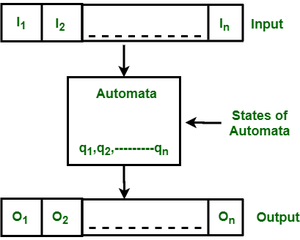
Figure: Features of Finite Automata
The above figure shows the following features of automata:
- Input
- Output
- States of automata
- State relation
- Output relation
A Finite Automata consists of the following:
Q : Finite set of states.
Σ : set of Input Symbols.
q : Initial state.
F : set of Final States.
δ : Transition Function.
Formal specification of machine is
{ Q, Σ, q, F, δ }FA is characterized into two types:
1) Deterministic Finite Automata (DFA):
DFA consists of 5 tuples {Q, Σ, q, F, δ}.
Q : set of all states.
Σ : set of input symbols. ( Symbols which machine takes as input )
q : Initial state. ( Starting state of a machine )
F : set of final state.
δ : Transition Function, defined as δ : Q X Σ --> Q.
In a DFA, for a particular input character, the machine goes to one state only. A transition function is defined on every state for every input symbol. Also in DFA null (or ε) move is not allowed, i.e., DFA cannot change state without any input character.
For example, below DFA with Σ = {0, 1} accepts all strings ending with 0.
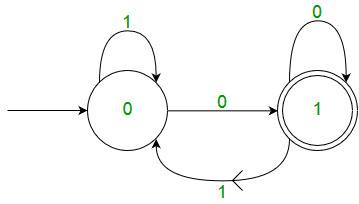
Figure: DFA with Σ = {0, 1}
One important thing to note is, there can be many possible DFAs for a pattern. A DFA with a minimum number of states is generally preferred.
2) Nondeterministic Finite Automata(NFA): NFA is similar to DFA except following additional features:
- Null (or ε) move is allowed i.e., it can move forward without reading symbols.
- Ability to transmit to any number of states for a particular input.
However, these above features don’t add any power to NFA. If we compare both in terms of power, both are equivalent.
Due to the above additional features, NFA has a different transition function, the rest is the same as DFA.
δ: Transition Function
δ:  Q X (Σ U ε ) --> 2 ^ Q.
As you can see in the transition function is for any input including null (or ε), NFA can go to any state number of states. For example, below is an NFA for the above problem.
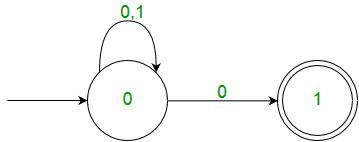
NFA
One important thing to note is, in NFA, if any path for an input string leads to a final state, then the input string is accepted. For example, in the above NFA, there are multiple paths for the input string “00”. Since one of the paths leads to a final state, “00” is accepted by the above NFA.
Some Important Points:
- Justification:
In case of DFA
δ : Q X Σ --> Q
In case of NFA
δ : Q X Σ --> 2Q
Now if you observe you’ll find out Q X Σ –> Q is part of Q X Σ –> 2Q.
On the RHS side, Q is the subset of 2Q which indicates Q is contained in 2Q or Q is a part of 2Q, however, the reverse isn’t true. So mathematically, we can conclude that every DFA is NFA but not vice-versa. Yet there is a way to convert an NFA to DFA, so there exists an equivalent DFA for every NFA.
- Both NFA and DFA have the same power and each NFA can be translated into a DFA.
- There can be multiple final states in both DFA and NFA.
- NFA is more of a theoretical concept.
- DFA is used in Lexical Analysis in Compiler.
- If the number of states in the NFA is N then, its DFA can have maximum 2N number of states.
Finite automata is a state machine that takes a string of symbols as input and changes its state accordingly. Finite automata is a recognizer for regular expressions. When a regular expression string is fed into finite automata, it changes its state for each literal. If the input string is successfully processed and the automata reaches its final state, it is accepted, i.e., the string just fed was said to be a valid token of the language in hand.
The mathematical model of finite automata consists of:
- Finite set of states (Q)
- Finite set of input symbols (Σ)
- One Start state (q0)
- Set of final states (qf)
- Transition function (δ)
The transition function (δ) maps the finite set of state (Q) to a finite set of input symbols (Σ), Q × Σ ➔ Q
Finite Automata Construction
Let L(r) be a regular language recognized by some finite automata (FA).
States : States of FA are represented by circles. State names are written inside circles.
Start state : The state from where the automata starts, is known as the start state. Start state has an arrow pointed towards it.
Intermediate states : All intermediate states have at least two arrows; one pointing to and another pointing out from them.
Final state : If the input string is successfully parsed, the automata is expected to be in this state. Final state is represented by double circles. It may have any odd number of arrows pointing to it and even number of arrows pointing out from it. The number of odd arrows are one greater than even, i.e. odd = even+1.
Transition : The transition from one state to another state happens when a desired symbol in the input is found. Upon transition, automata can either move to the next state or stay in the same state. Movement from one state to another is shown as a directed arrow, where the arrows points to the destination state. If automata stays on the same state, an arrow pointing from a state to itself is drawn.
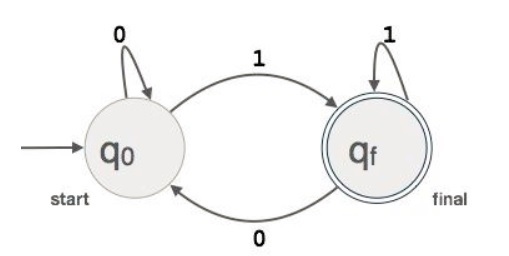
Example : We assume FA accepts any three digit binary value ending in digit 1. FA = {Q(q0, qf), Σ(0,1), q0, qf, δ}